Sales reps spend 60% of their time on nonselling work — writing emails, entering data, building quotes, and planning. When they finally get in front of a buyer, the materials they send need to do serious heavy lifting in a very small window.
The challenge for enterprise sales teams is that buying committees keep expanding, attention keeps shrinking, and the materials reps rely on often fall into one of two traps. They're either dense enough to require a decoder ring or so generic they could describe any vendor on the shortlist.
A strong sales one-pager sits in a different category, functioning as high-impact B2B sales collateral that speaks directly to the stakeholder reading it and moves the deal forward.
It speaks directly to the stakeholder reading it, connects a specific pain to a measurable outcome, and makes the next step obvious.
For field sellers managing complex, multi-stakeholder deals, a well-designed one-pager is one of the highest-leverage sales assets in the sales enablement toolkit — closer to a sell sheet built for decision makers than a brochure built for brand recognition.
This guide covers how to structure, write, design, and deliver a sales one-pager that earns attention from the first line and keeps momentum through to signature.
What is a sales one-pager?
A sales one-pager is a one-page document that gives a prospect a clear, concise summary of a product or solution: the problem it addresses, how it works, the value it delivers, and the next step to take. Sometimes called a business one-pager or company one-pager, depending on the context, the format condenses key information into a digestible format that respects the reader's time.
Sales teams use it as a leave-behind after a sales call, a pre-call primer for new stakeholders, or a shareable asset that a champion can forward internally without needing to explain the pitch themselves.
Where a full proposal or pitch deck walks through the details, a one-pager earns the right to that longer conversation and often complements a structured sales presentation. It answers three questions fast: why should I care, what does this do for someone like me, and what happens next.
A marketing one-pager might prioritize brand awareness or social media engagement, but a sales one-pager is built to advance a deal. The core message stays focused on the buyer's pain points, the value proposition, and a clear next step.
Sales one-pager examples
The format, messaging, and level of detail shift depending on where the prospect sits in the buying process and what the sales team needs the document to accomplish.
One-pagers show up at different points in the sales cycle depending on the use case:
Prospecting: Attached to outbound emails to give cold prospective clients a reason to engage
Discovery follow-up: Sent after an initial call to reinforce the problem-solution fit before a formal proposal
Internal selling: Shared by a champion with external stakeholders who weren't in the room, so key information travels without losing clarity
Event and conference handoffs: Given to potential clients at networking events and trade shows as a tangible reference that outlasts a booth conversation
Competitive displacement: Positioned against an incumbent by framing specific gaps the current solution leaves open
The following one-pager examples cover the most common use cases enterprise sales teams encounter across prospecting, deal progression, and competitive positioning.
1. Product overview one-pager
A product one-pager gives prospective clients a fast, top-level snapshot of what a product does, who it serves, and why it matters. It fits early in the funnel — attached to outbound emails, handed out at events, or shared after an initial intro call — when the buyer is still evaluating categories, not vendors.
A product overview one-pager includes:
A one-line description of what the product does and the core problem it solves
The target audience or buyer profile it serves
Three to five key features, each tied to a specific benefit
A brief ROI statement or quantified outcome that signals value without requiring a full business case
A single call to action, like booking a demo or visiting a product page
Product Overview -- [Product Name]
[Your Company Name]Product Overview
[Product Name]
The one-line pitch: what your product does and the core problem it solves.
Designed for [Target Audience / Buyer Profile] -- teams that need to [core job-to-be-done].
Key Features & Benefits
1 Feature One
One clear sentence describing what this feature does and the specific benefit it delivers to the user.
2 Feature Two
One clear sentence describing what this feature does and the specific benefit it delivers to the user.
3 Feature Three
One clear sentence describing what this feature does and the specific benefit it delivers to the user.
4 Feature Four
One clear sentence describing what this feature does and the specific benefit it delivers to the user.
5 Feature Five
One clear sentence describing what this feature does and the specific benefit it delivers to the user.
Proven Outcomes
00%
Metric One -- e.g., time saved per week
$0K
Metric Two -- e.g., avg. cost reduction
0x
Metric Three -- e.g., ROI within 90 days
Replace the placeholders above with real data, customer results, or industry benchmarks that resonate with your target buyer.
Ready to See It in Action?
Book a personalized 30-minute demo and see how [Product Name] can work for your team.
Questions? Reach us at [contact@yourcompany.com]
Book a Demo
[yourcompany.com/demo]
2. Problem-solution one-pager
The problem-solution one-pager opens with a clear problem statement — the pain a prospect is already feeling — and positions the product as the direct response. It mirrors how buyers think and aligns closely with approaches like gap selling, where the focus stays on the cost of inaction.
A problem-solution one-pager typically includes:
A specific, named problem that the target audience recognizes immediately, framed in their language
Two to three consequences of leaving that problem unaddressed, grounded in operational or financial impact
A concise description of how the solution addresses each pain point directly
A measurable outcome that connects back to the pain points and business impact introduced at the top
A call to action that moves the prospect toward a conversation, not a commitment
Problem-Solution -- [Product Name]
[Your Company Name]Problem & Solution
The Challenge
[Your target audience] struggles with [the core problem you solve].
[One or two sentences expanding on the real-world impact of the problem -- cost, time lost, risk, or missed opportunity -- to build urgency before presenting the solution.]
✕Without [Product Name]
!
Pain Point OneA brief description of the frustration, inefficiency, or risk this pain point creates for the buyer day-to-day.
!
Pain Point TwoA brief description of the frustration, inefficiency, or risk this pain point creates for the buyer day-to-day.
!
Pain Point ThreeA brief description of the frustration, inefficiency, or risk this pain point creates for the buyer day-to-day.
!
Pain Point FourA brief description of the frustration, inefficiency, or risk this pain point creates for the buyer day-to-day.
✓With [Product Name]
✓
Solution OneHow your product directly resolves Pain Point One -- be specific about the mechanism or capability that makes this possible.
✓
Solution TwoHow your product directly resolves Pain Point Two -- be specific about the mechanism or capability that makes this possible.
✓
Solution ThreeHow your product directly resolves Pain Point Three -- be specific about the mechanism or capability that makes this possible.
✓
Solution FourHow your product directly resolves Pain Point Four -- be specific about the mechanism or capability that makes this possible.
How It Works
1
Step One
Brief description of what happens in this step.
2
Step Two
Brief description of what happens in this step.
3
Step Three
Brief description of what happens in this step.
4
Step Four
Brief description of what happens in this step.
What Customers Say
"Replace this with a real customer quote that speaks directly to the problem being solved and the outcome achieved."
[First Last] -- [Title], [Company]
"Replace this with a real customer quote that speaks directly to the problem being solved and the outcome achieved."
[First Last] -- [Title], [Company]
"Replace this with a real customer quote that speaks directly to the problem being solved and the outcome achieved."
[First Last] -- [Title], [Company]
See exactly how [Product Name] solves these challenges for teams like yours -- in a personalized 30-minute demo.
Questions? [contact@yourcompany.com]
Book a Demo
[yourcompany.com/demo]
3. ROI-focused one-pager
When a buying committee needs internal justification to approve spend, the conversation shifts from features to financials. An ROI-focused one-pager becomes critical when deals move into later stages of the SaaS sales cycle and require financial justification. Champions also use it as an attachment to internal budget requests.
Where a product overview creates interest, an ROI one-pager creates urgency by quantifying what inaction costs. It includes:
A headline metric or financial outcome that anchors the entire page — revenue gained, cost reduced, or time recovered
A breakdown of how that outcome is calculated, using inputs the prospect can verify against their own numbers
A before-and-after comparison showing current-state costs against projected post-implementation performance
Supporting data points from customer results, industry benchmarks, or proprietary research
A call to action directed at the next approval step, such as scheduling a business case review
ROI Overview -- [Product Name]
[Your Company Name]ROI Overview
The Business Case
The measurable return on investing in [Product Name].
Customers typically see a full return within [X] months -- driven by [time savings / cost reduction / revenue lift]. Here is what the numbers look like.
00%
Reduction in [key cost or time metric]
Source or "Avg. across customers"
$0K
Average annual savings per team
Source or "Based on [N] customers"
0x
Return on investment within [X] months
Source or "Median customer result"
0 hrs
Saved per employee per week
Source or "Based on usage data"
Where the Value Comes From
⚡
Value Driver One -- e.g., Faster Workflows
One or two sentences explaining how this driver creates financial value -- time saved, headcount avoided, or errors eliminated.
→ [Quantified outcome, e.g., saves 5 hrs/week per rep]
💰
Value Driver Two -- e.g., Reduced Tool Costs
One or two sentences explaining how this driver creates financial value -- consolidation, reduced licenses, or lower overhead.
→ [Quantified outcome, e.g., replaces $20K/yr in tools]
📈
Value Driver Three -- e.g., Revenue Acceleration
One or two sentences explaining how this driver creates financial value -- faster cycles, higher win rates, or improved retention.
One or two sentences explaining how this driver creates financial value -- compliance, error avoidance, or churn prevention.
→ [Quantified outcome, e.g., avoids $50K+ in penalties]
The Cost of Doing Nothing
Ongoing Cost One
$0K/yr
A brief description of the recurring cost, waste, or lost opportunity that compounds every year without a solution.
Ongoing Cost Two
00 hrs/mo
A brief description of the recurring cost, waste, or lost opportunity that compounds every year without a solution.
Ongoing Cost Three
$0K risk
A brief description of the recurring cost, waste, or lost opportunity that compounds every year without a solution.
Illustrative ROI Summary
Value Category
Year 1 Benefit
Year 2 Benefit
Year 3 Benefit
Time savings (labor cost equivalent)
$[X]K
$[X]K
$[X]K
Tool / vendor consolidation
$[X]K
$[X]K
$[X]K
Revenue impact / pipeline acceleration
$[X]K
$[X]K
$[X]K
Risk / compliance avoidance
$[X]K
$[X]K
$[X]K
Investment (license + implementation)
($[X]K)
($[X]K)
($[X]K)
Net Return
$[X]K
$[X]K
$[X]K
Estimates based on a [team size] deployment. Actual results vary. Ask us for a customized model built on your numbers.
Real Results from Real Customers
[XX]% faster
[specific process or metric that improved]
"A short customer quote tying the result to a real business outcome they experienced after implementing [Product Name]."
[First Last] -- [Title], [Company]
$[X]K saved
[specific cost area, e.g., in annual tool spend]
"A short customer quote tying the result to a real business outcome they experienced after implementing [Product Name]."
[First Last] -- [Title], [Company]
Want a business case built on your numbers? We will model the ROI for your specific team size and use case -- no obligation.
Reach us at [contact@yourcompany.com]
Get Your ROI Model
[yourcompany.com/roi]
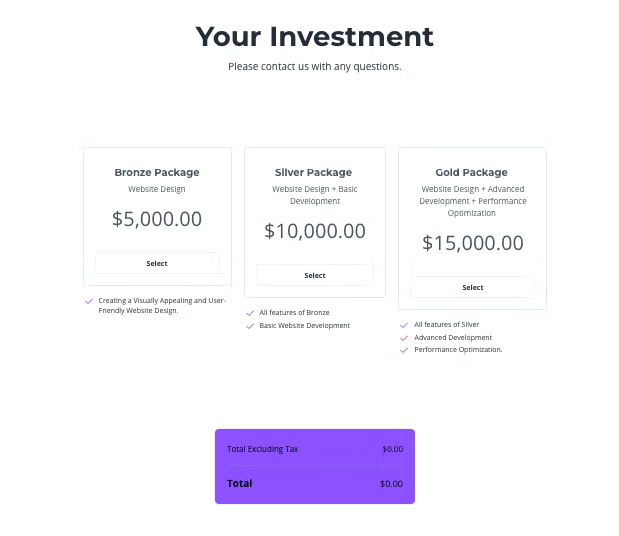
If the one-pager includes pricing information, use Qwilr’s quotes and dynamic pricing tables to present different pricing options or packages in a clear, easy-to-read format.
A use case one-pager narrows the lens from what a product does broadly to how it solves a specific problem for a specific team, role, or workflow. It bridges the gap between general product awareness and a tailored proposal, answering the question every stakeholder asks internally: "How would this work for us?"
Mid-funnel conversations are where this format carries the most weight. It typically includes:
A named scenario describing the team, workflow, or operational challenge being addressed
A short description of how the current process works without the solution, including specific friction points
A walkthrough of how the product fits into that workflow, focused on user actions rather than backend functionality
A before-and-after contrast that makes the improvement tangible — fewer steps, faster turnaround, reduced manual effort
A call to action tied to seeing the product in context, such as a tailored demo or pilot
Note: Products that serve multiple buyer personas benefit from separate one-pagers for each, because pain points, vocabulary, and success metrics differ across teams.
Use Case -- [Product Name]
[Your Company Name]Use Case
Use Case
How [Team / Role] uses [Product Name] to [achieve outcome].
A practical walkthrough of how [Product Name] fits into the [team name] workflow -- from the challenge they face to the results they see.
Buyer Profile
👤
[Job Title / Role] Primary user
🏢
[Company Type / Size] Org profile
🏭
[Industry or Vertical] Sector
🎯
[Primary Goal] Key objective
The Scenario
Setting the scene: [a one-line framing of the situation]
Two to three sentences describing a realistic day-in-the-life scenario for the buyer. Ground it in specifics -- what they are trying to accomplish, what gets in the way, and what the stakes are if they do not solve it. This section should make the reader think "that's exactly my problem."
Before & After Workflow
Without [Product Name]
1Manual step one -- describe the tedious or error-prone task the team does today.
2Manual step two -- another friction point that slows progress or creates risk.
3Manual step three -- handoff, delay, or rework that compounds the problem.
4Manual step four -- the final bottleneck before they can reach the desired outcome.
→
With [Product Name]
1Streamlined step one -- how the product eliminates or automates what was painful before.
2Streamlined step two -- the specific capability that removes friction at this stage.
3Streamlined step three -- the handoff or collaboration that now happens seamlessly.
4Streamlined step four -- the fast, confident path to the outcome they care about.
Outcomes for [Team / Role]
00%
[Outcome metric one]
A short note on what drives this result and why it matters to this specific team.
$0K
[Outcome metric two]
A short note on what drives this result and why it matters to this specific team.
0 days
[Outcome metric three]
A short note on what drives this result and why it matters to this specific team.
Works With Your Existing Stack
Integrates with:
[Tool 1][Tool 2][Tool 3][Tool 4][Tool 5]+ more
In Their Own Words
"
Replace this with a real customer quote from someone in the same role or industry as your target buyer. It should describe a specific before-and-after moment, not just general satisfaction.
[First Last] -- [Title], [Company] · [Industry]
[X]x
their key result
See how [Product Name] works for [Team / Role] teams like yours -- in a focused 30-minute walkthrough tailored to your workflow.
Questions? [contact@yourcompany.com]
See It in Action
[yourcompany.com/demo]
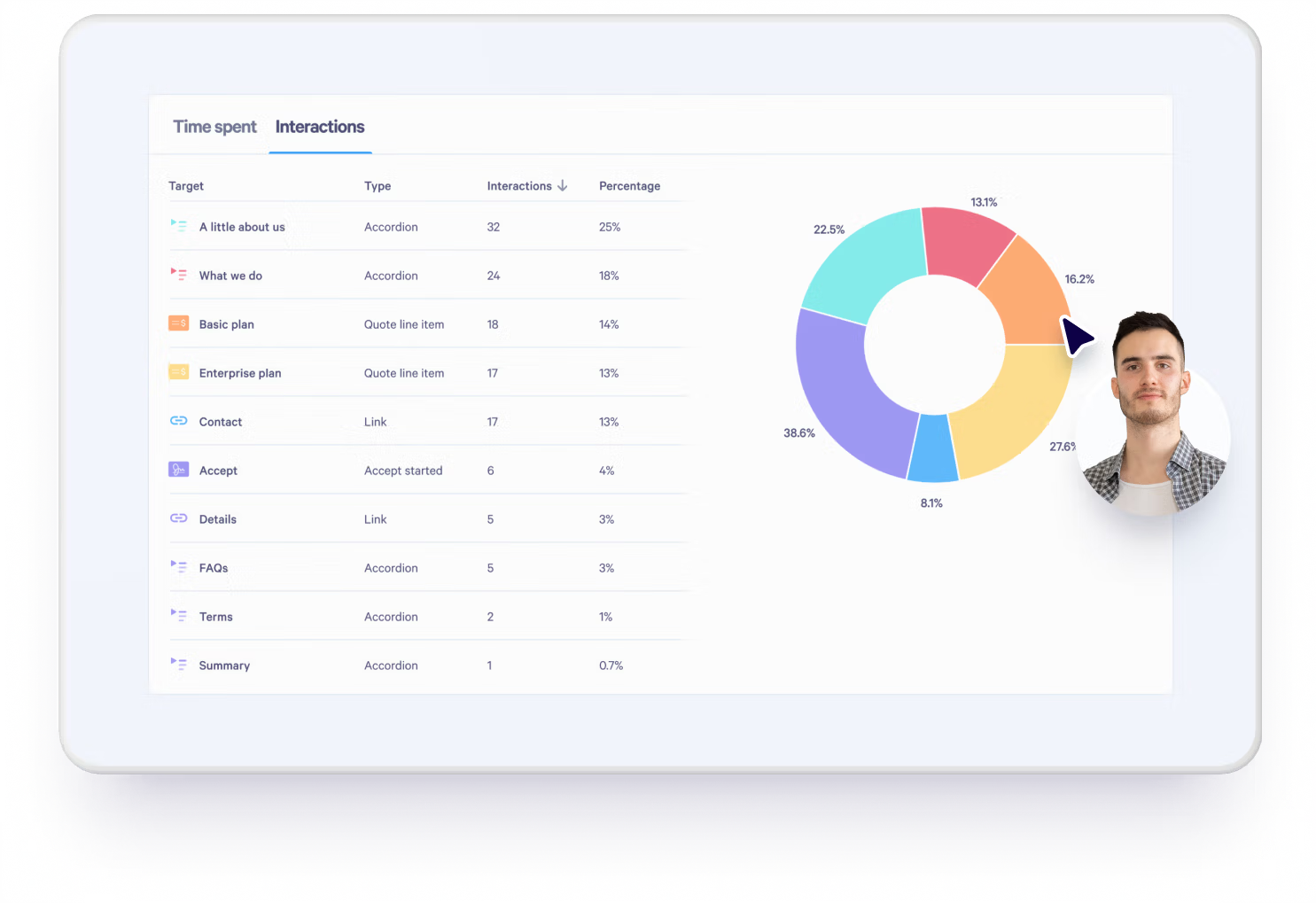
Qwilr allows users to create visually engaging, interactive case studies that showcase past projects and client success stories.
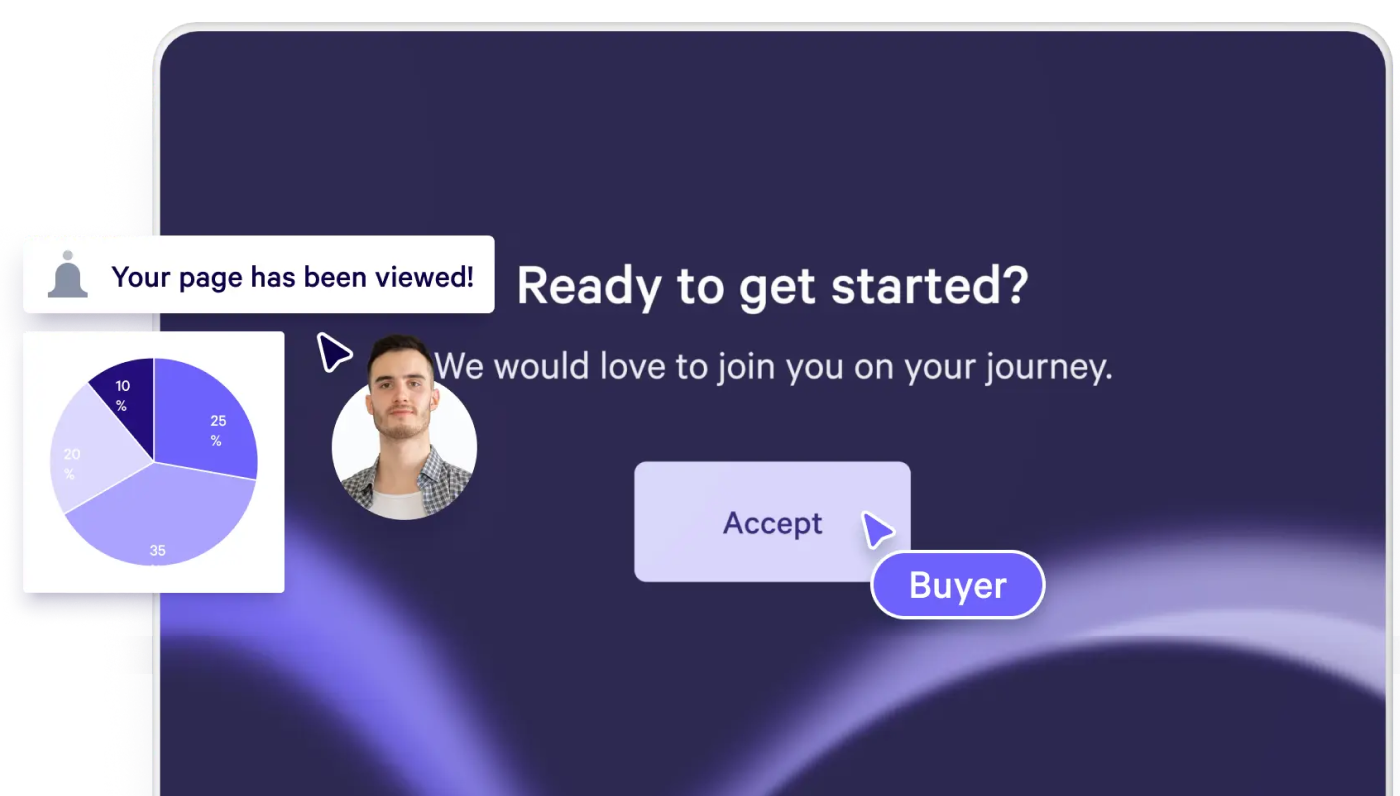
And with interactive features, like clickable buttons, embedded forms, and integrated documents (such as price lists or proposals), one-pagers provide a more engaging experience for potential clients.
5. Industry-specific one-pager
Horizontal products that serve multiple verticals face a recurring problem: generic messaging signals that the vendor hasn't done the work to understand the buyer's world. An industry-specific one-pager reframes a broad product around a single vertical's regulatory requirements, technical environment, and operational norms.
One product page on a website speaks to everyone. An industry-specific one-pager speaks to one buyer in one target market.
A clear statement of the industry-specific challenge, using terminology the buyer's team uses internally
Relevant compliance, regulatory, or security requirements the product meets in that vertical
Features or integrations pulled forward from the broader feature set based on what matters most in that industry
A customer result or proof point from a comparable organization in the same vertical
A call to action that references the buyer's context, such as a consultation focused on their industry's requirements
Industry One-Pager -- [Product Name]
[Your Company Name]Industry Solution
🏭 [Industry Name]
[Product Name] for [Industry Name] Companies.
Built for the specific workflows, compliance requirements, and pressures that [Industry] teams face -- not a generic platform retrofitted to your vertical.
[X]+
[Industry] customers
00%
Avg. [key metric] improvement
[X] mo
Avg. time to full deployment
$[X]M
Avg. annual value delivered
The [Industry] Landscape Today
📊Market Pressure One
One or two sentences describing a macro trend, regulatory shift, or competitive pressure that is reshaping how [Industry] companies must operate.
→ [Industry stat or benchmark, e.g., "72% of firms cite this as a top-3 priority"]
⚠️Market Pressure Two
One or two sentences describing a second trend -- labor costs, digital transformation, customer expectations, or supply chain complexity specific to this vertical.
→ [Industry stat or benchmark that adds urgency]
📉Market Pressure Three
One or two sentences on a third force -- margin compression, talent shortages, consolidation, or technology disruption affecting this industry right now.
→ [Industry stat or benchmark that adds urgency]
🔒Market Pressure Four
One or two sentences on compliance burden, audit risk, reporting requirements, or other regulatory pressures unique to [Industry] organizations.
→ [Industry stat or benchmark that adds urgency]
Top Challenges in [Industry]
1
Challenge One -- e.g., Fragmented Data Across Systems
A brief description of why this challenge exists in this industry specifically and the downstream effect it has on operations, cost, or risk.
$[X]K
avg. annual cost
2
Challenge Two -- e.g., Manual Compliance Reporting
A brief description of why this challenge exists in this industry specifically and the downstream effect it has on operations, cost, or risk.
[X] hrs
lost per week
3
Challenge Three -- e.g., Slow Cross-Team Handoffs
A brief description of why this challenge exists in this industry specifically and the downstream effect it has on operations, cost, or risk.
00%
of errors traced here
How [Product Name] Serves [Industry]
Capability One
A short explanation of how this capability is tailored to the workflows or requirements unique to [Industry] -- not just a generic feature description.
→ Addresses Challenge 1
Capability Two
A short explanation of how this capability is tailored to the workflows or requirements unique to [Industry] -- not just a generic feature description.
→ Addresses Challenge 2
Capability Three
A short explanation of how this capability is tailored to the workflows or requirements unique to [Industry] -- not just a generic feature description.
→ Addresses Challenge 3
Compliance & Standards
🛡️
Built to meet the regulatory requirements of [Industry].
A sentence or two on how [Product Name] is architected to support the compliance frameworks, data residency requirements, audit trails, or certifications most relevant to [Industry] buyers.
[Sub-segment or size, e.g., "Mid-market · Manufacturing"]
Challenge: [One line on what problem this customer needed to solve.]
00%
[Result metric one]
$[X]K
[Result metric two]
[X]x
[Result metric three]
[Company Name]
[Sub-segment or size, e.g., "Enterprise · Healthcare"]
Challenge: [One line on what problem this customer needed to solve.]
00%
[Result metric one]
$[X]K
[Result metric two]
[X]x
[Result metric three]
Talk to a [Industry] specialist at [Your Company Name] -- we will show you exactly how teams like yours are putting [Product Name] to work.
Reach us at [contact@yourcompany.com]
Talk to a Specialist
[yourcompany.com/industry]
6. Feature deep-dive one-pager
Some deals stall because the buyer can't visualize how a single capability works in practice. A feature deep-dive one-pager isolates one feature and explains it thoroughly — what it does, how a user interacts with it, and what outcome it produces. This format fits late-stage evaluations where the prospect has already narrowed the shortlist and needs granular detail to make a final call.
It becomes especially useful when buyers are comparing tools like the best proposal software or evaluating specific capabilities. The one-pager includes:
The specific feature and the problem it solves within the broader product
A step-by-step walkthrough or visual showing the feature in action
Key benefits framed around time saved, errors reduced, or workflows simplified
A screenshot, diagram, or workflow illustration that makes the functionality concrete
A call to action pointing toward a hands-on trial, sandbox environment, or technical demo
Resist the temptation to pack in adjacent features. The discipline of this format is focus — one feature, explained well enough that a prospect can assess fit without a live walkthrough.
Feature Deep-Dive -- [Feature Name]
[Your Company Name]Feature Deep-Dive
Feature Spotlight · [Product Name]
[Feature Name]
Part of [Module / Product Area]
One or two sentences on what this feature does, who uses it, and why it represents a meaningful capability -- not just a checkbox on a comparison sheet.
00%
of users who enable this feature report [key outcome]
$[X]K
avg. value unlocked per team annually
Why This Feature Exists
The Problem It Solves
Two to three sentences describing the specific friction, gap, or pain that led to building this feature. Ground it in the user's reality -- what were they doing before, why was it painful, and what was the cost of that pain?
The Design Intention
Two to three sentences on the principle behind how this feature was built -- the job it is designed to do, the outcome it optimizes for, and what makes the approach distinctive compared to alternatives.
How It Works
1
Step One -- [e.g., Connect Your Data Source]
Describe what the user does or what the system does automatically at this stage. Keep it concrete -- name the interface element, trigger, or mechanism involved.
💡 Pro tip or nuance: a short note on configuration options, edge cases, or a common best practice at this step that helps users get the most out of it.
2
Step Two -- [e.g., Define Your Rules or Parameters]
Describe what the user does or what the system does automatically at this stage. Keep it concrete -- name the interface element, trigger, or mechanism involved.
💡 Pro tip or nuance: a short note on configuration options, edge cases, or a common best practice at this step that helps users get the most out of it.
3
Step Three -- [e.g., The Feature Runs Automatically]
Describe what the user does or what the system does automatically at this stage. Keep it concrete -- name the interface element, trigger, or mechanism involved.
💡 Pro tip or nuance: a short note on configuration options, edge cases, or a common best practice at this step that helps users get the most out of it.
4
Step Four -- [e.g., Review Results and Take Action]
Describe what the user does or what the system does automatically at this stage. Keep it concrete -- name the interface element, trigger, or mechanism involved.
💡 Pro tip or nuance: a short note on configuration options, edge cases, or a common best practice at this step that helps users get the most out of it.
What's Included
⚙️Sub-Feature One
A brief description of this specific capability within the feature -- what it does and when a user would reach for it.
→ Benefit: [specific outcome or time saved]
📊Sub-Feature Two
A brief description of this specific capability within the feature -- what it does and when a user would reach for it.
→ Benefit: [specific outcome or time saved]
🔗Sub-Feature Three
A brief description of this specific capability within the feature -- what it does and when a user would reach for it.
→ Benefit: [specific outcome or time saved]
Technical Specifications
Specification
Details
Supported formats / inputs
[e.g., CSV, JSON, REST API, Webhook -- list what data sources or input types the feature accepts]
Processing / trigger model
[e.g., Real-time, batch nightly, on-demand -- describe how and when the feature activates]
Output / destinations
[e.g., Dashboard, email alert, API push, Slack notification -- where results land]
Permissions & roles
[e.g., Admin setup, available to all users, role-gated -- who can configure vs. view]
Limits / thresholds
[e.g., Up to 1M records, 100 rules per workspace -- key limits buyers should know]
Integrations
[e.g., Salesforce, HubSpot, Snowflake -- key platforms this feature connects with out of the box]
Data retention
[e.g., 90-day history, configurable per plan -- how long the feature's data is stored]
Outcomes Tied to This Feature
00%
Reduction in [specific task or error tied to this feature]
[X] hrs
Saved per week per team using this feature
$[X]K
Avg. cost impact directly attributable to this feature
[X] days
Avg. time to first value after enabling this feature
Plan Availability
[Starter / Essentials]
Entry tier
✓ Core version of [Feature Name] included
✓ Up to [X] [records / users / runs] per month
✗ Advanced configuration options
✗ API access & custom integrations
✗ [Premium sub-feature]
[Professional / Growth]
⭐ Most popular
✓ Full [Feature Name] capability
✓ Unlimited [records / users / runs]
✓ Advanced configuration options
✓ API access & custom integrations
✗ [Enterprise-only sub-feature]
[Enterprise]
Full suite
✓ Everything in Professional
✓ [Enterprise-only sub-feature]
✓ Dedicated onboarding & support
✓ Custom SLAs & data residency
✓ Volume pricing & SSO
Want to see [Feature Name] live in a working environment? We will walk you through a hands-on demo tailored to your team's workflow.
Questions? [contact@yourcompany.com]
See It Live
[yourcompany.com/demo]
7. Comparison one-pager
Buyers evaluating multiple vendors build their own comparison grids, whether or not a sales team provides one. A comparison one-pager takes control of that narrative by framing differentiators on the vendor's terms, highlighting where the product leads and where alternatives fall short.
This format lands hardest at the bottom of the funnel, when procurement is scoring vendors or a champion needs ammunition to justify their recommendation internally. It could cover:
A side-by-side table comparing two to four solutions across the criteria that matter most to the buyer
Key differentiators called out with brief context, not just checkmarks
A "best for" summary that positions each option for a specific use case or buyer profile
Proof points or data that substantiate the comparison rather than relying on subjective claims
A call to action inviting the prospect to validate the comparison through a demo or reference call
Comparison -- [Product Name] vs. [Competitor / Status Quo]
[Your Company Name]Competitive Comparison
How We Compare
[Product Name] vs. [Competitor / Status Quo] -- an honest side-by-side.
A straightforward look at how [Product Name] stacks up on the criteria that matter most to [target buyer] -- so you can make a confident, informed decision.
[A]
[Product Name]
[Your tagline or category, e.g., "Purpose-built for X"]
VS
[B]
[Competitor / Status Quo]
[Their category or how buyers usually describe them]
Feature & Capability Comparison
Capability
[Product Name]
[Competitor]
Why it matters
Core Functionality
[Capability 1 -- e.g., Real-time data sync]
✓Included
✗
Brief note on the impact of having vs. not having this.
[Capability 2 -- e.g., Native mobile app]
✓Included
◑
Brief note on the impact of having vs. not having this.
[Capability 3 -- e.g., Custom reporting]
✓Included
✗
Brief note on the impact of having vs. not having this.
Integrations & Ecosystem
[Capability 4 -- e.g., 200+ native integrations]
✓Included
◑
Brief note on the impact of having vs. not having this.
[Capability 5 -- e.g., Open API]
✓Included
✓
Brief note on the impact of having vs. not having this.
[Capability 6 -- e.g., Bidirectional CRM sync]
✓Included
✗
Brief note on the impact of having vs. not having this.
Security, Compliance & Administration
[Capability 7 -- e.g., SOC 2 Type II certified]
✓Included
✗
Brief note on the impact of having vs. not having this.
[Capability 8 -- e.g., Role-based permissions]
✓Included
◑
Brief note on the impact of having vs. not having this.
Brief note on the impact of having vs. not having this.
[Capability 10 -- e.g., Dedicated onboarding]
✓All plans
◑
Brief note on the impact of having vs. not having this.
✓ Fully supported · ◑ Partial or add-on · ✗ Not available · Based on publicly available information as of [Month Year]. Subject to change.
Where [Product Name] Wins
🚀
Differentiator One
A brief explanation of the specific advantage -- what [Product Name] does differently, why that gap exists, and the concrete impact it has on the buyer's outcome.
🔒
Differentiator Two
A brief explanation of the specific advantage -- what [Product Name] does differently, why that gap exists, and the concrete impact it has on the buyer's outcome.
⚡
Differentiator Three
A brief explanation of the specific advantage -- what [Product Name] does differently, why that gap exists, and the concrete impact it has on the buyer's outcome.
Common Questions When Comparing
Concern
"[Competitor] already does [X] -- why would we switch?"
→
Our answer
A concise, honest response that acknowledges what is true, then pivots to the specific gap or trade-off the buyer is likely not seeing yet. Be direct and factual -- not defensive.
Concern
"[Competitor] is cheaper. How do you justify the price difference?"
→
Our answer
A concise, honest response that reframes price in terms of total cost of ownership, hidden fees, or the value of capabilities they would be giving up at the lower price point.
Concern
"We're already using [Competitor] -- switching seems risky."
→
Our answer
A concise response that addresses migration effort, data portability, and onboarding support -- and references a customer who made the same switch successfully.
Customers Who Switched
Switched from [Competitor Name]
[XX]%
[Key improvement after switching, e.g., faster time-to-close]
"A short quote from the customer describing what made them switch and what surprised them most about [Product Name] after the move."
[First Last] -- [Title], [Company]
Switched from [Competitor / Status Quo]
$[X]K
[Key savings or value unlocked after switching]
"A short quote from the customer describing what made them switch and what surprised them most about [Product Name] after the move."
[First Last] -- [Title], [Company]
See [Product Name] head-to-head in a live demo -- bring your toughest comparison questions and we will answer them on the spot.
Questions? [contact@yourcompany.com]
Compare Live
[yourcompany.com/demo]
8. Case study snapshot one-pager
A full case study can run several pages. A case study snapshot condenses that narrative into a single page built for speed, giving the buyer enough social proof to build customer trust without requiring them to read a long-form document.
A great example of an effective one pager is a case study snapshot that mirrors the reader's industry, company size, and business challenge simultaneously.
Seeing a comparable organization achieve measurable results reduces the perceived uncertainty of moving forward. A case study snapshot includes:
The client's industry, company size, and relevant context in one to two sentences
The specific challenge or pain point that triggered the engagement
The solution delivered, described in concrete terms rather than abstract capabilities
Measurable results with specific numbers — percentage improvements, time saved, revenue impact
A direct customer testimonial from the client stakeholder who owned the project
Case Study -- [Customer Name]
[Your Company Name]Customer Case Study
Case Study
[Customer Company Name]
One sentence on what the customer does, their market position, and why their story is relevant to your target buyer -- e.g., "A fast-growing [industry] company serving [X] customers across [Y] markets."
🏭
Industry
[Industry / Vertical]
👥
Company Size
[e.g., 500-1,000 employees]
🌍
Region
[e.g., North America]
📦
Products Used
[Plan / Module / Features]
📅
Customer Since
[Month Year]
00%
[Key result 1 -- e.g., reduction in processing time]
$[X]K
[Key result 2 -- e.g., annual cost savings]
[X]x
[Key result 3 -- e.g., ROI within first year]
[X] wks
[Key result 4 -- e.g., time to full deployment]
The Story
🏢 Situation
Two to three sentences setting the scene -- the customer's business context, team structure, and the environment they were operating in before engaging with [Product Name]. Help the reader picture the before state.
⚠️ Challenge
Two to three sentences describing the specific problem or friction they were experiencing. Be concrete -- what was breaking down, how often, and what it was costing them in time, money, or risk.
✓ Solution
Two to three sentences on how they evaluated and deployed [Product Name] -- which capabilities they used, how the rollout was structured, and what made the implementation successful.
Implementation Timeline
1
Week [X]
Kickoff & Setup
Brief note on what happened at this stage -- e.g., data migration, integrations, configuration.
2
Week [X]
Pilot Launch
Brief note on what happened at this stage -- e.g., first team onboarded, initial workflows live.
3
Week [X]
Full Rollout
Brief note on what happened at this stage -- e.g., all teams onboarded, advanced features enabled.
4
Month [X]
Results Realized
Brief note on when measurable outcomes first appeared and what the team noticed first.
Two sentences explaining how this result was achieved -- which feature drove it, how it changed the team's workflow, and why it matters beyond the number.
Impact Area Two -- e.g., Cost Savings
$[X]K
[Specific metric, e.g., saved annually in tool consolidation]
Two sentences explaining how this result was achieved -- which feature drove it, how it changed the team's workflow, and why it matters beyond the number.
Impact Area Three -- e.g., Team Adoption
[XX]%
[Specific metric, e.g., active users within 30 days of launch]
Two sentences explaining how this result was achieved -- which feature drove it, how it changed the team's workflow, and why it matters beyond the number.
Impact Area Four -- e.g., Revenue Impact
[X]x
[Specific metric, e.g., pipeline growth attributed to this workflow]
Two sentences explaining how this result was achieved -- which feature drove it, how it changed the team's workflow, and why it matters beyond the number.
In Their Own Words
"Replace this with the customer's most compelling quote -- one that captures a specific before-and-after moment, a surprise, or an outcome that exceeded their expectations. Ideally 2-3 sentences from a named senior stakeholder."
[FL]
[First Last]
[Title] · [Customer Company Name]
What's Next for [Customer Name]
🚀
Building on early success -- expanding to [new team / use case / region].
Two sentences on how the customer is growing their use of [Product Name] -- new departments adopting it, additional features being rolled out, or plans to expand across regions or subsidiaries. This signals long-term value and builds buyer confidence.
Want results like [Customer Name]? We will build a plan tailored to your team's size, stack, and goals -- starting with a 30-minute discovery call.
Questions? [contact@yourcompany.com]
Get Similar Results
[yourcompany.com/demo]
9. Integration-focused one-pager
For operations teams, IT leaders, and RevOps buyers, a product's value often depends less on what it does standalone and more on how it connects to the systems already in place. An integration-focused one-pager addresses that concern directly by showing how the product fits into an existing tech stack.
This format resonates with technical evaluators who need to assess compatibility before they'll advocate internally. It typically includes:
A list of supported integrations relevant to the buyer's stack, prioritized by the ones that matter most in their workflow
One to two workflow examples showing how data moves between the product and connected systems
Setup requirements and implementation complexity — how long it takes and what resources are involved
Security or compliance standards the integrations meet, particularly for buyers in regulated industries
A call to action aimed at a technical review, integration consultation, or sandbox walkthrough
Integrations -- [Product Name]
[Your Company Name]Integrations
Connect Everything
[Product Name] fits into the tools your team already uses.
[Product Name] connects natively with [X]+ platforms -- so your data flows where it needs to go, without manual exports, duplicate entry, or broken handoffs.
[X]+
Native integrations out of the box
[X] min
Avg. time to connect a new integration
REST
Open API for custom integrations
Real-time
Bidirectional data sync
Why Integrations Matter
🔀
Eliminate Manual Data Entry
Data that lives in silos forces teams to copy-paste between tools -- creating errors, delays, and wasted hours. [Product Name] keeps everything in sync automatically.
⚡
Trigger Actions Across Tools
An event in one system -- a closed deal, a submitted form, a new ticket -- can instantly kick off actions in [Product Name] and downstream tools without any manual handoff.
📊
Unify Your Reporting
Pull data from every connected system into a single view -- so leadership gets one source of truth instead of five spreadsheets stitched together before every review.
Integration Ecosystem
CRM & Sales
[Salesforce]
[HubSpot]
[Pipedrive]
[Zoho CRM]
Productivity
[Slack]
[MS Teams]
[Google Workspace]
[Notion]
Data & Analytics
[Snowflake]
[BigQuery]
[Looker]
[Custom DB]
Ops & Support
[Jira]
[Zendesk]
[ServiceNow]
[Via Zapier]
Native (built-in)
Partner-built
API / custom
How the Integration Works
🔧
[Connected Tool]
e.g., Salesforce, Slack, Snowflake
Trigger eventPush data
⇄
Sync
⚙️
[Product Name]
Processes, transforms, and routes data according to your rules
Map fieldsApply logicRoute actions
→
Output
✅
Outcome
Data lands where it needs to go -- updated, clean, and on time
Updated recordsAlerts sentReports refreshed
Setup in 4 Steps
1
Connect
Authenticate [Product Name] with your tool using OAuth or an API key -- no engineering needed.
~2 minutes
2
Map Fields
Match the fields from your connected tool to the corresponding fields in [Product Name] using a visual mapper.
~5 minutes
3
Set Triggers
Define what events or schedules drive the sync -- on creation, update, deletion, or on a recurring interval.
~3 minutes
4
Go Live
Test with a sample record, confirm everything looks right, and activate the integration with one click.
When a deal closes in Salesforce, [Product Name] automatically creates the corresponding record, assigns the right owner, and triggers the next workflow -- no manual handoff required.
[X] hrs
saved per rep per week
🔔
Real-Time Alerts -- e.g., [Product Name] → Slack
When a threshold is crossed or an anomaly is detected in [Product Name], the right person gets a Slack message instantly -- with context and a direct link to take action.
00%
faster response to critical events
📤
Data Warehouse Export -- e.g., [Product Name] → Snowflake
Automatically push [Product Name] data to your data warehouse on a schedule -- keeping your BI dashboards, models, and reports up to date without manual exports or ETL scripts.
$[X]K
saved in engineering time annually
Technical Specifications
Connectivity
API typeREST & GraphQL
Auth methodsOAuth 2.0, API key, SAML
WebhooksInbound & outbound
Sync frequencyReal-time or scheduled (min. [X] min)
Data Handling
Record volumeUp to [X]M records/sync
Data formatsJSON, CSV, XML, Parquet
Field mappingVisual mapper + custom transforms
Error handlingAuto-retry with audit log
Reliability
Uptime SLA[X]% guaranteed
Sync monitoringReal-time dashboard + alerts
RollbackPoint-in-time restore available
SupportIntegration-dedicated support team
Enterprise
Custom connectorsAvailable via SDK
IP allowlistingSupported
Data residencyUS, EU, APAC
Audit loggingFull sync history retained [X] days
Security & Compliance
🛡️
Your data never leaves your control.
All integration traffic is encrypted in transit and at rest. [Product Name] never stores credentials -- only short-lived tokens. Every sync is logged for audit purposes, and all integrations respect the permission scopes you define.
TLS 1.2+AES-256 at restSOC 2 Type IIGDPR readyZero credential storage
Already using [Tool]? We will connect it to [Product Name] during your onboarding -- usually in the first session. No engineering required.
Questions? [contact@yourcompany.com]
See Integrations Live
[yourcompany.com/integrations]
10. Executive summary one-pager
An executive summary one-pager distills a complex solution, strategy, or recommendation into a format designed for time-constrained decision-makers who need the bottom line before anything else.
This format is built for internal circulation — the kind of document a VP forwards to the C-suite with "worth a look" in the subject line. It generally covers:
Two to three key insights or findings that frame the opportunity or problem at a strategic level
A concise recommendation or proposed course of action
Expected outcomes tied to business metrics the reader already tracks
Supporting evidence kept to a minimum — one or two data points, not a full research appendix
A clear next step that requires minimal effort from the reader, such as approving a meeting or greenlighting a pilot
Executive Summary -- [Product Name]
[Your Company Name]
Executive Summary[Month Year]
Executive Briefing
[Product Name]: The strategic case for [outcome].
A concise overview of the opportunity, what [Product Name] does, and why organizations like yours are acting on it now. Prepared for [Recipient Name / Title] at [Prospect Company].
Company Snapshot
Founded[Year]
Headquarters[City, Country]
Customers[X]+ organizations
Category[Product category]
Stage / Funding[e.g., Series B · $[X]M]
Recognized by[e.g., Gartner, G2, Forbes]
The Opportunity & Our Answer
🏔 The Market Opportunity
Two to three sentences on the size and urgency of the problem -- the market gap, macro trend, or structural shift that makes this moment the right time for [Product Name]. Ground it in data where possible: market size, growth rate, or a stat that signals urgency for a senior audience.
✦ Our Solution
Two to three sentences on what [Product Name] does -- the core capability, the category it operates in, and the business outcome it delivers. Write for a decision-maker who needs to understand fit in under 30 seconds, not a technical buyer who needs a feature list.
By the Numbers
[X]K+
Organizations using [Product Name] globally
[X]x
Average ROI within the first [X] months
[X]%
Customer retention rate year over year
[X]mo
Average time from contract to full deployment
Three Strategic Advantages
01
[Strategic Advantage One]
A brief explanation of what makes this a durable, defensible advantage -- not just a feature, but a structural or architectural reason why [Product Name] wins here consistently.
02
[Strategic Advantage Two]
A brief explanation of what makes this a durable, defensible advantage -- not just a feature, but a structural or architectural reason why [Product Name] wins here consistently.
03
[Strategic Advantage Three]
A brief explanation of what makes this a durable, defensible advantage -- not just a feature, but a structural or architectural reason why [Product Name] wins here consistently.
Why Act Now
📈
Market Timing
A brief note on a macro trend, regulatory deadline, or competitive dynamic that makes waiting costly -- e.g., a window that is narrowing or a cost that is compounding.
⚙️
Technology Inflection
A brief note on a platform shift, AI capability, or infrastructure change that makes now uniquely the right moment to deploy -- and that waiting means starting behind.
🏆
Competitive Pressure
A brief note on what peers and competitors are already doing -- and what the cost of inaction looks like in 12-18 months if this is deprioritized.
Executive Validation
"Replace with a quote from a C-suite or VP-level customer that speaks to business impact, strategic fit, or organizational transformation -- not product features."
[First Last] -- [Title], [Company]
→ [Headline result, e.g., 40% cost reduction in Year 1]
"Replace with a second senior quote that addresses a different dimension of value -- risk reduction, competitive edge, or speed to results -- to speak to a broader executive audience."
[First Last] -- [Title], [Company]
→ [Headline result, e.g., $2M in annual savings]
Investment & Path Forward
Pricing Overview
[Starter / Essentials]
Up to [X] users · Core capabilities
From $[X]/mo
[Professional / Growth]
Up to [X] users · Full platform
From $[X]/mo
[Enterprise]
Unlimited users · Custom contract
Custom
All plans include onboarding, support, and a [X]-day money-back guarantee.
Recommended Next Steps
1
Executive Discovery Call -- 30 min
Align on your strategic priorities and confirm fit before any further investment of time.
2
Tailored Demo -- 45 min
A live walkthrough built around your environment, data, and use cases -- not a generic product tour.
3
Pilot Proposal -- 1 week
A scoped proof-of-value with defined success criteria, timeline, and investment -- ready to present to your board or CFO.
Ready to explore whether [Product Name] is the right fit? Let's start with a 30-minute executive conversation -- no slides, no pitch, just an honest discussion.
Reach us directly at [executive@yourcompany.com]
Request a Briefing
[yourcompany.com/exec]
11. Event and campaign one-pager
Trade shows, product launches, and seasonal campaigns create a narrow window where attention is high but follow-through is uncertain. An event one-pager captures that momentum as a tangible reminder of why the conversation started and what to do next.
Unlike a product overview, this format is built around a specific moment. The messaging ties directly to the event's theme, a new release, or a limited-time offer that gives the prospect a reason to act within a defined window. Most often, it includes:
A headline tied to the event, launch, or campaign that anchors the one-pager in a specific context
A brief description of what's being promoted and why it matters right now
Two to three key highlights — new features, exclusive offers, or partnership announcements relevant to attendees
Social proof or a data point that reinforces urgency without resorting to pressure tactics
A call to action with a clear deadline or next step, such as booking a post-event demo or claiming an offer
Timing determines this format's shelf life. Pair it with a post-event outreach sequence and follow up emails that reference the same messaging to keep potential clients engaged after the initial handoff.
"[One-line tagline that captures the spirit and promise of the event.]"
📅[Day, Month Date, Year]
⏰[Start Time] - [End Time] [Timezone]
📍[Venue / City or "Virtual"]
👥[Expected attendance, e.g., 500+ attendees]
Register by
[Early Bird Deadline Date]
Register Now →
About This Event
🎤 What It Is
Two to three sentences describing the event format, theme, and what makes it distinct from others in your space. Mention the core topic, the mix of sessions, and the energy or experience attendees can expect to walk away with.
🔥 Why It Matters Now
Two to three sentences on the market moment or business challenge that makes this the right event at the right time. Give attendees a reason to prioritize this over competing demands on their calendar -- urgency, trend, or milestone.
Who Should Attend
👤
[Role One]
e.g., VPs of Sales looking to modernize pipeline strategy
🏢
[Role Two]
e.g., RevOps leaders managing tooling and process alignment
e.g., Founders and executives evaluating strategic investment
Event Agenda
Time
Session
Format
Speaker
[9:00 AM]
Opening Keynote: [Session Title]
Brief description of the session focus and key takeaway for attendees.
Keynote
[Speaker Name]
[10:00 AM]
[Session Two Title]
Brief description of the session focus and key takeaway for attendees.
Panel
[Moderator Name]
[11:00 AM]
[Session Three Title]
Brief description of the session focus and key takeaway for attendees.
Workshop
[Facilitator Name]
[12:00 PM]
Lunch Break & Networking
Structured networking with table topics and hosted introductions.
Networking
--
[1:00 PM]
[Session Four Title]
Brief description of the session focus and key takeaway for attendees.
Keynote
[Speaker Name]
[2:00 PM]
Closing & Key Takeaways
Summary of the day's themes and next steps for attendees to act on.
Close
[Host Name]
Featured Speakers
[FL]
[First Last]
[Title]
[Company]
[FL]
[First Last]
[Title]
[Company]
[FL]
[First Last]
[Title]
[Company]
[FL]
[First Last]
[Title]
[Company]
What You Will Take Away
🧠
Takeaway One
A specific, tangible thing attendees will learn, build, or walk away with -- not a vague promise, but a concrete deliverable or insight.
🤝
Takeaway Two
A specific, tangible thing attendees will learn, build, or walk away with -- not a vague promise, but a concrete deliverable or insight.
📋
Takeaway Three
A specific, tangible thing attendees will learn, build, or walk away with -- not a vague promise, but a concrete deliverable or insight.
Sponsors & Partners
Gold Sponsors
[Sponsor One][Sponsor Two]
Silver Sponsors
[Sponsor Three][Sponsor Four][Sponsor Five]
Registration
Secure your spot before prices increase.
Early bird pricing ends [Date]. Seats are limited to [X] attendees -- reserve yours now to guarantee access to all sessions, workshops, and networking.
General Admission
Full day access
$[XXX]
VIP / Team Pass
+ recordings & workshops
$[XXX]
Virtual Access
Livestream + on-demand
$[XXX]
Questions about the event, group rates, or speaking opportunities? We would love to hear from you.
Reach us at [events@yourcompany.com]
Register Now
[yourcompany.com/event]
12. Partnership one-pager
Co-selling and channel partnerships introduce a wrinkle that single-vendor materials can't address: the buyer needs to understand the combined value of two products working together, not just one. A partnership one-pager frames that joint value proposition clearly enough that both sales teams can use it in their own sales conversations.
This usually includes
A statement of the shared problem both products solve together that neither addresses as well independently
A description of how the integration or partnership works in practice — what connects, what data flows, and what the user experience looks like
Distinct benefits each product contributes to the partnership, so the buyer sees complementary strengths rather than overlapping features
A customer example or use case showing the partnership in action
A co-branded call to action that routes the prospect toward the right team, whether that's a joint demo, a partner landing page, or a shared sales contact
Partnership -- [Your Company Name]
[Your Company Name]Partnership Program
Partner With Us
Grow together with [Your Company Name].
Our partner program is built to help [agencies / resellers / technology partners / consultants] grow their business, deliver more value to their clients, and earn meaningful revenue alongside [Product Name].
[Your Company]
[Product / Platform]
+
[Partner Name]
[Their specialty]
Why Partner Together
✦ What We Bring
A brief description of what [Your Company] contributes to the partnership -- platform, customer base, brand, or technology.
A second contribution -- sales support, co-marketing budget, or leads you pass to partners.
A third contribution -- training, certification, or dedicated partner success resources.
A fourth contribution -- revenue share, margin, or deal registration protection.
=
✦ What Partners Bring
A brief description of what the ideal partner contributes -- market access, domain expertise, or an existing client base.
A second contribution -- implementation capability, integration expertise, or vertical specialization.
A third contribution -- trusted advisor relationships or influence with a specific buyer segment.
A fourth contribution -- co-selling motion, referrals, or a complementary product that creates a better joint solution.
Partnership Types
🤝
Referral Partner
Refer qualified leads to [Your Company] and earn commission on every closed deal -- no delivery responsibility required. Ideal for consultants and advisors.
ConsultantsAdvisorsInfluencers
🔁
Reseller Partner
License and resell [Product Name] to your clients under your own commercial terms -- with our full enablement, training, and support behind you.
VARsMSPsAgencies
🔗
Technology Partner
Build a native integration or joint solution on top of [Product Name] -- and list it in our marketplace to reach [X]K+ customers actively looking for your capabilities.
ISVsSaaS companiesPlatforms
Partner Tiers & Benefits
Benefit
Registered
Silver
Gold
Platinum
Revenue share / margin
[X]%
[X]%
[X]%
[X]%
Deal registration protection
✓
✓
✓
✓
Partner portal & sales tools
✓
✓
✓
✓
Co-branded marketing assets
✗
✓
✓
✓
MDF / co-marketing budget
✗
Limited
✓
✓
Dedicated partner success manager
✗
✗
✓
✓
Joint go-to-market planning
✗
✗
Quarterly
Monthly
Executive sponsorship
✗
✗
✗
✓
Annual revenue threshold
$[X]K+
$[X]K+
$[X]K+
$[X]K+
What Partners Earn
💰
Up to [X]%
Revenue share on referred and resold deals
🎯
$[X]K
Average partner revenue in year one
📈
[X]x
Average services revenue for every $1 of licenses sold
🔁
[X]%
Recurring commission on renewals and expansions
Support & Enablement
🎓
Partner Certification & Training
On-demand training library, live instructor-led sessions, and a formal certification program -- so your team can sell and deliver [Product Name] with confidence from day one.
🗂
Sales & Marketing Toolkit
Co-branded pitch decks, battle cards, email sequences, landing page templates, and demo environments -- everything you need to go to market without starting from scratch.
🤝
Co-Selling Support
Our partner sales team will join calls, help scope deals, and provide technical support through the sales cycle -- so you never have to go into a complex opportunity alone.
📊
Partner Portal & Deal Tracking
A dedicated partner portal for registering deals, tracking pipeline, accessing resources, submitting MDF requests, and monitoring your commission payments in real time.
From a Current Partner
"
Replace this with a real quote from an existing partner -- ideally one that speaks to the revenue opportunity, the quality of support, or a specific moment that demonstrated the strength of the relationship.
[First Last] -- [Title], [Partner Company]
$[X]K
earned in first year of partnership
How to Get Started
1
Apply Online
Submit a short application at [yourcompany.com/partners] -- takes under 5 minutes.
2
Partner Onboarding
Complete a 60-minute onboarding call with your partner success manager to get set up.
3
Get Certified
Complete the free certification track so your team is ready to sell and deliver confidently.
4
Start Earning
Register your first deal, co-sell with our team, and start generating revenue together.
Ready to explore what a partnership with [Your Company Name] could look like for your business? Let's start with a 30-minute intro call.
Contact our partnerships team at [partners@yourcompany.com]
Apply to Partner
[yourcompany.com/partners]
13. Objection-handling one-pager
Every sales team hears the same objections on repeat — pricing concerns, implementation timelines, security requirements, or skepticism about switching costs. An objection-handling one-pager pre-empts those concerns by addressing them head-on in a format the prospect can review independently or share with internal skeptics.
This format works best when a rep knows the specific objection blocking a deal and needs something more structured than a verbal response to move the conversation forward. It commonly consists of:
The sales objection stated plainly, in the buyer's own language rather than a sanitized version
A direct response backed by data, customer evidence, or a concrete explanation of how the concern is addressed
A supporting proof point — a customer quote, benchmark, or third-party validation that reinforces the response
Context that reframes the objection within the broader unique value proposition of the solution
A call to action that invites the prospect to test the claim, such as a pilot, reference call, or technical review
Building a library of objection-handling one-pagers organized by concern gives sales reps a ready-made resource for the most common deal blockers. Reps save time on repetitive responses, and the messaging stays consistent across the team.
Objection Handling -- [Product Name]
[Your Company Name]Objection Handling Guide
Sales Enablement · [Product Name]
Every objection. A confident answer.
Responses, proof points, and follow-up moves for the six objection types your team faces most -- so every rep goes into every conversation prepared.
💰 Price
💬
"It's too expensive. We can't justify the cost right now."
Your Response
I hear you -- can I ask what you're currently spending on [the manual process / existing tool]? Most customers find [Product Name] pays for itself in [X] months through [time saved / tool consolidation]. I can put together a quick ROI model based on your team size if that would help make the internal case.
→ Avg. payback: [X] months→ [X]x ROI in year one→ [Customer] saved $[X]K in 90 days
💬
"Can you do better on price?"
Your Response
Before I explore what's possible -- is this a hard budget ceiling, or about getting more value for the investment? Sometimes restructuring the package or a phased start fits better than a straight discount.
💡 Understand the real constraint before discounting. A structuring conversation often works better than a price concession.
⏳ Timing
💬
"Now isn't the right time. Maybe next quarter."
Your Response
Completely fair. What would need to be true for next quarter to be the right time? I want to work around your calendar -- I just don't want [the problem] to keep costing you [X] in the meantime.
→ Cost of delay: $[X]K per quarter→ Avg. onboarding: [X] weeks
Smart evaluation to run. The two places we hear buyers hit a wall with [Competitor] are [gap 1] and [gap 2]. If those matter to you, the comparison changes. What's the most important thing you're trying to solve? That'll tell us quickly where we stand.
→ Win rate vs. [Competitor]: [X]%→ [X] customers evaluated both and chose us
💬
"We already use [Competitor] and don't see a reason to switch."
Your Response
Reasonable -- switching has real costs and I won't push unless there's a genuine reason. Can I ask: is there anything about [Competitor] you wish worked differently? If gaps are small, stay where you are. If they're material, it might be worth a 20-minute look.
💡 Don't lead with switching costs. Let them surface the dissatisfaction -- then position against it.
❓ Need & Fit
💬
"I'm not sure this is a problem we need to solve right now."
Your Response
Fair -- how is your team currently handling [the core problem]? If it's working, I'll tell you honestly whether we'd add enough value to justify a change. Most buyers find [X hrs/week or $X] sitting in a process they've stopped noticing because it became normal.
→ Avg. hidden cost of status quo: $[X]K/yr
🛡️ Trust & Risk
💬
"We've been burned by a vendor before. How do we know you'll deliver?"
Your Response
Don't take my word for it -- talk to two or three customers who came from a similar situation. I'll connect you directly. We also offer a [pilot / phased rollout] so you can verify results before any full commitment.
→ [X]% retention rate→ [X]+ references available→ Pilot option available
👤 Authority
💬
"I need to get buy-in from [my manager / IT / finance]."
Your Response
Makes sense -- let's build the internal case together. Tell me who the key stakeholders are and what each needs to see. I can prepare an executive one-pager, ROI model, or security brief -- whatever gets you over the line fastest.
→ Exec one-pager ready→ ROI model for finance→ Security brief for IT
When to Escalate or Re-Qualify
⚠️ The Stall
Repeated "let me think about it" with no specific blocker. Meetings keep getting pushed.
→ "What would need to change for this to become a priority?"
👻 The Ghost
No reply after two follow-ups. Deal went quiet after positive momentum.
→ Send a "permission to close" email to force a response.
🔒 Budget Freeze
Genuine budget lock -- money isn't available until next quarter or year.
→ Offer a pilot, phased start, or signed LOI with delayed activation.
Pocket Phrases
📌 Adapt these in the moment
Too expensive
"Compared to what? Let's look at what staying still is costing you."
Not right now
"What would make next quarter different from today?"
Use a competitor
"Is there anything about it you wish worked differently?"
Gone silent
"Should I close this out, or is there still something worth exploring?"
Needs approval
"Let's build the case together -- what will [stakeholder] need to see?"
Need to think
"What's the one thing that would make this an easy yes?"
Stuck on a deal or objection not covered here? Reach out to [Your Company Name] sales leadership -- we will help you work through it.
Contact [sales@yourcompany.com] or ping your sales manager directly.
Get Deal Support
[yourcompany.com/sales-resources]
14. Implementation and onboarding one-pager
Procurement and operations teams often hesitate at the point of commitment because they can't see what happens after the contract is signed. An implementation one-pager removes that uncertainty by mapping out the onboarding process in a format that makes the transition feel manageable for project managers and stakeholders alike.
It includes:
A phased onboarding timeline showing what happens in week one, month one, and beyond
Clear ownership for each phase — what the vendor handles and what the buyer's team is responsible for
Key milestones and checkpoints that signal progress, such as data migration completion, team training, or first workflow live
Available support resources including dedicated account managers, documentation, and training sessions
A call to action aimed at scheduling a scoping call or reviewing a detailed implementation plan
Specificity matters here more than in almost any other format. Vague promises about "seamless onboarding" or "dedicated support" carry no weight with an operations lead evaluating three vendors. Concrete timelines, named resources, and defined responsibilities build the confidence needed to move from verbal agreement to signed contract.
Our structured onboarding program gets your team live fast -- with a dedicated Customer Success Manager, step-by-step guidance, and proven playbooks used by [XXX]+ customers.
[X]
Days to Go-Live
[X]%
On-Time Launch Rate
[X]/[X]
CSAT Score
[X]+
Customers Onboarded
Implementation Roadmap
Four Phases to Full Deployment
Every customer follows a proven, repeatable process -- tailored to your team size and complexity.
Phase 1
Kickoff & Setup
CSM introduction call
Stakeholder alignment
Environment provisioning
SSO & security config
Days 1-[X]
Phase 2
Data & Integration
CRM / data import
API & webhook setup
Workflow configuration
QA & testing
Days [X]-[X]
Phase 3
Training & Enablement
Admin training session
End-user workshops
Custom playbook build
Sandbox practice period
Days [X]-[X]
Phase 4
Go-Live & Adoption
Production launch
Hypercare support window
[X]-day check-in call
Success review & QBR plan
Days [X]-[X]
What You'll Need
Your Pre-Launch Checklist
Most customers complete preparation within [X] business days. Here's what to have ready before kickoff.
👤
Project Sponsor & Admin Owner
Designate a project lead (IT or Ops) and at least one admin user who will own day-to-day configuration.
🔗
Integration Credentials
API keys or OAuth access for [CRM], [HRIS], or other systems to be connected during Phase 2.
📋
Data Export / Migration File
Historical records in CSV or [format] from your existing tool. Our team handles the import and mapping.
🔐
SSO / Directory Access
SAML 2.0 or OIDC metadata from your IdP ([Okta / Azure AD / Google]). Required for enterprise plans.
🏗️
Workflow & Process Docs
Existing SOPs, templates, or process maps your team uses -- so we can replicate or improve them in [Product].
🗓️
Training Availability
[X]-[X] hours of availability across [X] sessions for admins, and [X] hour for end-user training.
Success Milestones
How We Measure a Successful Launch
Clear gates at every stage so you always know where you stand.
Day [X]
Kickoff Complete
Stakeholders aligned, project plan shared, environment access granted.
✓ Gate 1
Day [X]
Integrations Live
All connected systems passing data; test records verified by your admin.
✓ Gate 2
Day [X]
Training Complete
[X]% of core users have completed admin and end-user training modules.
✓ Gate 3
Day [X]
Production Go-Live
Live environment confirmed; hypercare window begins; launch metrics baseline set.
✓ Gate 4
Day [X]
[X]-Day Health Check
Adoption rate reviewed, open issues resolved, expansion opportunities identified.
✓ Gate 5
Support & Resources
You're Never On Your Own
Multiple channels available from day one -- and beyond.
🧑💼
Dedicated CSM
Your named Customer Success Manager owns the relationship from kickoff through renewal.
Assigned at Contract
🎓
Training & Certification
On-demand video library, live webinars, and a certification track for power users and admins.
[X]+ Courses Available
📚
Knowledge Base
Step-by-step articles, integration guides, and video tutorials -- searchable 24/7.
[docs.company.com]
💬
In-App Live Chat
Instant access to support agents for configuration questions during business hours.
[X] min avg. response
🏘️
Customer Community
Connect with [X,XXX]+ peers, share best practices, and vote on product features.
[community.company.com]
🚨
Priority Support (Enterprise)
Dedicated support queue, SLA-backed response times, and escalation path to engineering.
[X]-Hour SLA
Your Customer Success Team
Meet Your Onboarding Partner
Every customer is assigned a named CSM before day one.
[XX]
[CSM First Last]
Customer Success Manager -- [Region / Segment]
Specializes in [industry/team type] accounts. Average tenure [X] years. Has onboarded [X]+ customers including [Notable Logo] and [Notable Logo].
Pricing is one of the most requested and most mishandled pieces of sales collateral. Too much detail overwhelms the buyer before they understand the value. Too few triggers follow-up emails that slow the deal. A pricing one-pager strikes that balance by presenting cost structures clearly enough for a budget conversation without turning into a full commercial proposal.
This format fits mid-to-late-stage deals where the buyer has expressed intent and needs to socialize costs internally. It covers:
A pricing structure overview — per-seat, tiered, usage-based, or custom — with enough detail for the buyer to understand how costs scale
A breakdown of what each tier or package includes, focused on the capabilities that differentiate each level
Add-ons, implementation fees, or variable costs flagged transparently so the buyer isn't surprised later
A brief value anchor — a ROI figure, cost-per-outcome metric, or customer benchmark that frames the price against the return
A call to action directing the buyer toward a pricing consultation, custom quote, or interactive pricing experience
Avoid locking this one-pager into specific dollar amounts if pricing is negotiable or changes frequently. Framing the structure and logic behind pricing gives the buyer only what they need to move the conversation forward internally, while leaving room for a tailored quote once the scope is confirmed.
How to create a sales one-pager that drives action
A one-pager can have the right content and still underperform because of how it's structured, designed, or delivered. The creation process matters as much as the content itself. The following practices cover the decisions that shape whether a good one pager earns attention or loses it.
Lead with a headline that names the problem or outcome
A headline built around the product name or a generic tagline gives the reader no reason to invest another second. Compare these two approaches:
"XYZ Platform: Next-Generation Revenue Intelligence" — tells the reader what the product calls itself
"Cut forecast variance by 40% with real-time pipeline visibility" — tells the reader what they get
The second version works harder because it leads with a result the buyer is already trying to achieve. It signals relevance before the reader processes a single detail about the product.
Strong one-pager headlines follow a pattern. They name a specific pain point, a measurable outcome, or a scenario the reader recognizes from their own day-to-day. They avoid vague language like "streamline operations" or "drive growth" in favor of language grounded in the buyer's reality. The headline's job is to capture the reader's attention before anything else on the page.
Structure content for scanning
Most stakeholders will scan for the section relevant to their role, extract key details and key points, and decide in seconds whether to engage further or move on.
Place the most critical information — the problem, the outcome, the proof — in the top third of the page where it's visible without scrolling or flipping. Group related details under clear subheadings so a CFO can jump to ROI and an IT lead can jump to integrations without wading through irrelevant sections.
A few structural principles that support fast comprehension:
Keep paragraphs to two or three sentences maximum so the main point of each section is immediately clear
Use bullet points for lists of features, benefits, or requirements rather than embedding them in prose
Bold key figures or outcomes so they're visible during a quick scan
Maintain consistent spacing between sections so the page feels organized rather than crowded
White space is functional. Generous spacing between sections gives the eye natural resting points and makes individual elements easier to isolate. An easily digestible format keeps decision makers moving through the page rather than abandoning it.
Use visuals that carry information
Visual aids earn their place on a one-pager when they do work that text cannot do as efficiently. Stock photography, decorative icons, and generic illustrations consume space without advancing the reader's understanding and on a single page, every square inch matters. Visual elements and design elements that pull their weight include:
Comparison tables that let the reader evaluate options at a glance
Simple charts or graphs that quantify a result or trend
Product screenshots showing the actual interface a buyer would use
Workflow diagrams mapping how the product connects to existing systems or processes
Before-and-after layouts that make an improvement tangible
Anchor claims in data or proof
Unsupported benefits read like marketing copy. A claim like "reduces onboarding time" invites skepticism. "Reduced onboarding time by 35% for a 200-person sales team" gives the reader — and every stakeholder the champion forwards it to — something concrete to evaluate.
Proof points that strengthen a one-pager include:
Customer metrics tied to a named outcome — percentage improvements, time saved, revenue impact
Industry benchmarks from recognized sources that contextualize the claim
Direct customer testimonials attributed to a named person and role
Third-party validation like analyst findings, review platform ratings, or awards
End with one clear call to action
A one-pager with two or three calls to action — "book a demo, visit our website, download the whitepaper" — asks the reader to make a choice at the exact moment they should be making a move.
For example:
Early-stage one-pagers point toward a conversation: "Book a 15-minute intro call."
Mid-funnel documents push toward validation: "Schedule a tailored demo" or "See it in your environment."
Late-stage materials aim for commitment: "Review the proposal" or "Start your pilot."
Make the CTA visually distinct from the rest of the page — a button, a bolded line, a clearly separated section — so it's impossible to miss during a scan. A clear call to action with enough specificity that the reader knows just what happens after they act separates a good one pager from one that stalls. "Get in touch" is vague. "Book a 20-minute pipeline review with our team" tells the prospect exactly what they're committing to and what they'll get from it.
Design for how the one-pager will travel
A one-pager rarely stays with the person who receives it first. A champion forwards it to their VP while a procurement lead prints it for a review meeting. How the document performs across those contexts depends on decisions made before it's ever sent.
Designing for travel means accounting for these realities:
Test the one-pager on mobile screens, not just desktop — a significant percentage of stakeholders will open it on a phone first
Ensure the file size is small enough to attach to an email without triggering spam filters or download friction
Include the company name, contact information, and a URL on the document itself so essential information and business information remain accessible even when the one-pager is separated from the original email thread
For web-based formats, track engagement so the sales team knows when the document is opened, forwarded, and which sections receive attention
Qwilr's proposal analytics show when a one-pager is viewed, how long each section holds attention, and whether it's been shared with additional stakeholders.
Make a one-pager that moves deals forward with Qwilr
An effective one-pager has to earn its place in an inbox, survive being forwarded across a buying committee, and still communicate its value proposition when the sender isn't in the room. Static PDFs and generic one-pager templates make that harder than it needs to be.
Qwilr gives sales teams a faster way to make a one-pager that matches how modern buyers evaluate, share, and approve. With a drag-and-drop editor, reps can build polished, on-brand sales content in just a few clicks.
Kiran is a content marketing strategist with over nine years of experience creating research-driven content for B2B SaaS companies like HubSpot, Sprout Social, and Zapier. Her expertise in SEO, in-depth research, and data analysis allow her to create thought leadership for topics like AI, sales, productivity, content marketing, and ecommerce. When not writing, you can find her trying new foods and booking her next travel adventure."